

Search: Clearing 3 Rucks
Maul and Ruck - Clearing the Ruck
Clearing the tackle area with pace relies on committed support. Clearance rucking is a dynamic method of restarting the attack if the defence has managed to create a breakdown.
 8:10
8:10
Ruck Clearing and Decision Making
Advanced clearing exercises for senior players. The support player makes a decision on how to clear out the ruck based on the position of the opposition.
3. Ruck Touch
To watch over 2500+ videos join now for free!
JOIN NOW 4:55
4:55
Ruck Clearing Exercises
Two crucial clearance techniques - the saddle roll, and the duck and clean. It's important for players to practice these at length, under pressure, under fatigue, and with an element of decision-making in order to best re-create a match situation.

Women's - Accurate clearing of players 3
 3:27
3:27
Breakdown - Clear & Kick
Teach your players how to kick the ball at the ruck. With players sometimes reluctant to give away penalties this technique is a great way to turnover the ball and stay on your feet
 4:30
4:30
Small-side game - Ruck Touch
There are many versions of ruck touch with the support players needing to recognise the needs of the tackled player.
The defence should be conditioned to provide increasing pressure to the tackle area. This will develop the situation recognision of the attacking players who must play accordingly. Robotics in rucking regardles of the situation should be discouraged and the option of picking upthe ball and going forward should be an option
 2:18
2:18
USA Sevens - Learn The Rules Of The Ruck
With less players the breakdown is much cleaner in Seven's and knowing the laws and being accurate in your skills wins matches. Mike Friday clarifies what can be a complex area and why many coaches focus on this facet of the game
 2:59
2:59
Quins Defence - Tackling in units 3 v 3
This exercise is part of a tackle technique progression and pitches 3 attackers v 3 defenders. As in match play the attacking players will present different challenges to the defenders. The coaches can choose to alter the conditions to put more or less pressure on the players
 3:31
3:31
Ruck touch - Focus on rolling players away
A key technique at the breakdown is the ability to roll players away, this applies when your opponent already has a good body position over the ball. Danny Wild from Leeds carnegie uses a game and breakout sessions to deliver his session
Step 5 - Introducing the 3 v 3 Scrum
 1:49
1:49
Decision making at the breakdown - Ruck touch
Coaching players to make the right decision at the breakdown is a complex challenge for coaches. In this video Danny Wild from Leeds carnegie uses a whole - part - whole approach to help improve the players decision making
Maul and Ruck - Under 13s and 14s Ruck
Training through traditional drills does not develop game understanding and players often become robotic in their behaviour
Conditioned games promote game understanding and encourage players to recognise the needs at any given situation
The drill should be used only to refine technique and the danger is to develop players that act without game understanding
QBE - Ruck Touch
 2:17
2:17
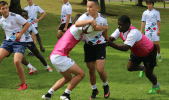
Ruck Touch Rugby
Coaches can use games to introduce all skills for your age group. If you are very specific about the conditions you apply then players will learn these skills in a fun and enjoyable game
 4:43
4:43
Rucking - Live With 5
A clever and competitive practise using 5 players that involves passing, tackling and then making the crucial decision of what to do at the breakdown. This can be done from Under 12's upwards
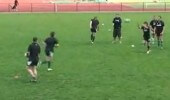
Passing 4 v 3 reset
A progression from 2 v 1 , 3 v 2 to 4 v 3
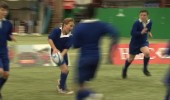
Maul and Ruck - U9 Coaching
Notice how these players do not naturally set up rucks. Both teams try to keep the ball away from breakdown situations.
What would these games look like if the coaches stepped in and insisted on rucking?
 0:26
0:26
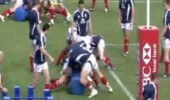
3 v 2 in Channel
A development of the 2 v 1 and 3 v1 drills, the attackers now must beat 2 defenders. This requires more decision-making ability as the movements of the defenders could change every time. Players must communicate as well as continue to perform their handling and running skills.
 1:03
1:03
British Lions - tackle then Jackal then clear out
Many of these drills require repetition, here we see how the importance of good body shape in contact can be practiced as both the jackler and those clearing out the tackle
 0:24
0:24
Men's - Exiting the 22m 3
Men's - Exiting the 22m 3
 0:56
0:56
Lions - 3&5 man scrum practice
A progression from the 3 man scrum - developing body shape and positions
 0:15
0:15
Women's - 2 v 3 1
Women's - 2 v 3 1
 0:51
0:51
Women's - Patterns of Play 3
Women's - Patterns of Play 3
 0:27
0:27
Men's - Strike Moves 3
Men's - Strike Moves 3
 0:19
0:19
Men's - 3 v 2 1
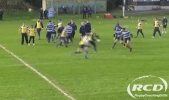
A passage of play that shows how to attack with more attackers than defenders, a 3 v 2. The winger shows that strong running and determination can break tackles. Click on the practises in this section for coaching ideas
 0:46
0:46
3 v 2 and then another defender
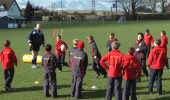
Develop decision-making skills in attack. 3 attackers must beat 2 defenders, before facing a third immediately after.
 2:15
2:15
Passing - 3 v 2 Live Defenders
Gradually progress from 2 static defenders, to 3 v 2 roaming defenders. The first two players must draw their defenders before giving the pass.
 0:51
0:51
Attacking progression's 4 v 3
A progression from 3 v 2s, this drill is closer to a game situation, where there are more decisions for the attacking players to make. The gaps could appear in a variety of locations and they have several passing /running options. With 4 attacking players, you may wish to utilise your basic strike moves.
Maul and Ruck - Under 10s and 11s Mauling
Notice how the tackled player often remains on their feet and a mass of pulling and pushing begins
When a player is taken to the ground, the supporting players try to pick the ball up. There is not a natural inclination to ruck
 0:23
0:23
Men's - Lineout maul good defence 3
Men's - Lineout maul good defence 3
Maul and Ruck - Maul Gain Lines
With the maul, the gain line is fluid and the defence can be forced onto the back foot
With the ruck, the gain line is static and the defence are often set and on the front foot
 1:00
1:00
Rucking Zone
A tiring exercise of continuous rucking. Encourage your players to maintain good standards even when tiring and highlight the importance of getting straight up after one breakdown to make another.
 0:42
0:42
Junior - Accurate clearing of players 1
Junior - Accurate clearing of players
 1:06
1:06
Contact Square - Inside Clear
All attacking players need to fix their opposite defender.
Step 3 - Introducing the 1 v 1 Scrum
 1:29
1:29
Andy Farrell's 3 Top tips For Defence
 0:28
0:28
3 v 1 in Channel
A progression from the 2 v 1, where a second pass is encouraged to move the ball away from the defender.
 3:14
3:14
The Importance of Basic Breakdown Skills
Continuously we see that the best teams are those that perform the basic skills better than their opponents. Basic skills such as passing, catching, running, tackling, and rucking. The breakdown is an essential element to the game as teams look to control momentum. Mastering the basic rucking and clearing techniques gives many teams the edge, and the quick ball that is required to enable their attack.
 0:54
0:54
Change the point of attack - 4 v 3
This drill allows you to develop decision making by varying the attack and defence continually thus accelerating learning
 0:33
0:33
3 v 2 in channel
A good progression from the 2 v 1 drill
 0:47
0:47
Lions 09 - Clearing the tackler away
With the new adjustments around the tackle zone, what variation would you adopt now so that this drill is now legal?

Sevens - Classic Tackle 3
British Lions - tackle then jackal then clear out
This technique proved so successful they adjusted the rules to prevent its use, what was the rules change and can you coach it?
Sevens - Offloads 3
 0:28
0:28
Sevens - Straight Scrums 3
 0:42
0:42
Sevens - Wheeled Scrums 3
 1:14
1:14
Sevens - Patterns of Play 3
Working in units and working through phases is crucial to modern day sevens and in this clip the White team show great technique and patience to work their way up the field to score. Key factors : Ball retention - Communication - Work in units - Accurate passing - Patience - Stamina
 0:38
0:38
Sevens - Full Lineout 3
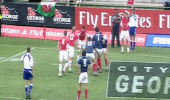
Accurate skills are the key to lineouts in seven's, a combination of movement, lifting and throw combine to make an effective restart for the attacking team. The shape of the attacking side is pre planned to create a mis - match with a faster player v a slower one. key factors : Pre call the move - Fast feet - Strong core for jumper - Support from both players to lift the jumper - Jumper to jump - Accurate throw - Support he jumper to the ground - Offload pass to scrum half
Sevens - Standard restart with good catch 3
Maul and Ruck - Practice Relevance
Consider the relevance of each practice
Make practices as realistic to the game as possible in order to maximise the learning process
Sevens - Turnovers and move the ball 3
British lions - team play 3
team play practice in a semi-opposed style assists the players in learning their roles and responsibilities

Sevens - Accurate clearing of players 2

Sevens - Accurate clearing of players 1

Sevens - Good contact body position/ball presentation 3
 0:23
0:23
Lions 09 - 3-man Scrum Practice
Develop the front row as a foundation for the building of the scrum
 0:40
0:40
IRB Men's - Offloads 3
A quick lineout allows players to attack a "broken field" defence. Running at space moves the defenders and the suport player comes from depth behind the attacker to score. Key factors : Loud communication - Accurate spin pass - Attacking space - Trail support - Pop pass - Quick running
Scrum Factory - 3. TOP With Rugby Balls
Expensive training equipment is not necessary and the simple rugby ball can provide an excellent technical and conditioning work out
Level 2 - Back Row Example Clip 3

Men's - Accurate clearing of players 2
 1:04
1:04
Lions 09 Backs defence 3
A clip with a progression on defensive systems from the 2009 Lions Tour

Women's - 2 v 3 2

Junior - 3 v 2 2

Junior - 3 v 2 1
 0:33
0:33
Lions 09 Backs support lines 3
Lions 2009 support drills, with a progression

Women's - Turnovers and move the ball 3
4 v 3 after 5m reset
Core skills training
Tackle technique 3
Materiality Clip 11 - Ruck Management
Maul and Ruck - Spin Maul
The spinning or rolling maul is an effective weapon when executed at speed. Notice what happens to the pace of the attack when the ball goes to floor with a breakdown

Junior - Accurate clearing of players 2

Women's - Accurate clearing of players 2

Women's - Accurate clearing of players 1

Junior - Good contact body position/ball presentation 3
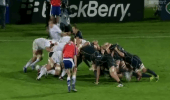
Men's - Wheeled Scrums 3
An example of a wheeled scrum
 1:13
1:13
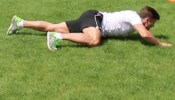
Fitness - Reptile crawls for rucking
Fitness exercises to help players improve their effectiveness in contact are very popular at present. Jack Crehan talks through this exercise and demonstrates how it should be done

Women's - Offloads 3
 1:43
1:43
Broncos 4 - 6 v 3 Identify space
Players to attack with "Heads up" and identify where colleagues have space. Supporting players to call early to the ball carriers. Defenders to stay tight to not let attack through the middle spaces easily
 2:02
2:02
Broncos 3 - Develop waves of attack
The first wave of attackers identify space and punch through the first line of defence. The ball carrier looks to move the ball quickly and away from covering defenders. This exercise tries to copy game situations as players cover their team mates in defence
 1:27
1:27
Turnover session - Clearing
Breaking down the turnover situation into separate technical elements, players can work on their essential skills.
Here, in a series of progressions, the emphasis is on the first defender to arrive at the breakdown. They should attack the breakdown and fight to get through and past the ball.

Junior - Classic Tackle 3
Women's - Wheeled Scrums 3
Maul and Ruck - Maul Leg Drive
Staying on the feet and maintaining aggressive leg drive, can be very difficult to defend
Women's - Straight Scrums 3
 0:14
0:14
Lions 09 - backline defence inown 22 option 3
Where you are on the pitch can determine you defensive system
 0:23
0:23
Lions 09 lineout 3
Lineout variation and practice

Men's - Clips of Coaches 3
 0:26
0:26
Tackle bag drill 3 man support after tackle
This is a very effective drill for developing decision making and awareness in support runners off a tackle situation
Materiality Clip 9 - Backfoot at Ruck
 0:13
0:13
Attacking in waves of 3
The ability to realign quickly is important to developing the back play and counter attacking. Coaches can vary the numbers and timing of the first pass to make this exercise easier or more demanding. Key factors : Run straight - Comunicate early - Uniform distance and depth - Catch & pass in one movement - Hips straight - Hands & armes across the body - Realign quickly - Aerobic fitness
 1:16
1:16
Passing - 3 v 2 Static Defenders
Progress to working in 3s against two static defenders. The pressure is on the middle player to hold their depth and perform a quick pass.
 1:00
1:00
Introduction to tackling - Step 3
Repetitive exercises can help players become familiar with tackling technique.
Infringements Clip 3 - Cynical Play
Small -sided game - 5 v 3
This is an intuitive decision-making pratice
 0:06
0:06
3-man lifting practice with pads
Progress lifting practises with more movement as is required in matches. The coach can alter things to make the exercise easier or more demanding. Key factors : Communication - Fast feet - Straight back - Squat / bend the knee's - Lock out arms
 1:01
1:01
Learning to spin pass 3
To practice the core passing technique before integrating into a moving drill or game.
 0:08
0:08
Defence - 3. Press Up and Out
This illustration is an up-and-out system and not a drift
This relies on the defenders continuing to press forward, closing the space as they shadow the attacking players
 0:28
0:28
Sevens - Standard restart with attack winning ball 3
A well organised re start with one main attacker challenging for the ball with support both in front and behind him, if the ball is knocked either side of the main catcher the ball will be gathered by his teammates. Great leg drive to continue the attack and a very long pass to complete the scoring. Key factors : Accurate kick - Focus on the ball - Sideways jump - Catch ball above head - Structured support
