

Search: Lions 09 Defence 04
Lions 09 defence 04
Lions 2009 defensive systems
 0:37
0:37
Lions 09 backs defence 4 man on man
Lions 2009 defence clip
 0:47
0:47
Lions 09 - Team Defence
Practice of team defence is important for reinforcing effective systems of defence that require aspects such as communication, pressure and drifting
To watch over 2500+ videos join now for free!
JOIN NOW 0:44
0:44
Lions 09 Backs defence 2
A clip from the 2009 Lions
 1:04
1:04
Lions 09 Backs defence 3
A clip with a progression on defensive systems from the 2009 Lions Tour
 0:57
0:57
Lions 09 Backs defence 1
A clip from the 2009 on defence systems
 0:16
0:16
Lions 09 - backline defence in own 22
Where you are on the pitch can deterrmine the defensive system you play
 0:17
0:17
Lions 09 - backline defence - centre pitch
Where you are on the pitch can determine the defensive system that you can employ.
 0:14
0:14
Lions 09 - backline defence inown 22 option 3
Where you are on the pitch can determine you defensive system
Lions 09 - backline defence in own 22 option 2
Defensive systems change according to where the team is on the pitch
 0:38
0:38
Lions 09 - linespeed defence drill
Developing linespeed is fundamental to applying pressure to an attack line
 0:45
0:45
Lions 09 - Strike Moves
The Lions drill for developing awareness of attack and defence options
Lions 09 - Lions speed and tracking the player
Developing linespeed, footwork and tracking
 0:33
0:33
Lions 09 Backs support lines 3
Lions 2009 support drills, with a progression
 0:33
0:33
Lions 09 backs support lines 2
Lions 2009 support and continuity work
Lions 09 Attack plays 2
A clip on attacking options from the 2009 Lions
 0:17
0:17
Lions 09 Lineout 1
The Lions practice their lineouts
 1:10
1:10
Lions 09 - Double-tackle
A good practice to work on stopping an effective ball carrying player
 0:22
0:22
Lions 09 strike move 8
Developing play through the backs
 0:47
0:47
Lions 09 - Lineout Movement
A dynamic practise for speed and quality of lifting in lineouts. This exercise can be used for 15's and 7's and for different age groups. The coaches can vary the distance of the cones and progress to both lifters moving. Coaches can add some fun by making it a competition. Key factors : The jumper must jump - Core body strength - Keep body stiff and straight - Lifters work together - Lock out arms - Bring the jumper down safely
 0:23
0:23
Lions 09 - 3-man Scrum Practice
Develop the front row as a foundation for the building of the scrum
 0:51
0:51
Lions 09 - Phase Play
This team play practice requires the team to be able to attacke with width and focusing on ball retention
Lions 09 Strike Moves 07
Developing attacking plays through the backs
 0:23
0:23
Lions 09 lineout 3
Lineout variation and practice
 0:47
0:47
Lions 09 - Clearing the tackler away
With the new adjustments around the tackle zone, what variation would you adopt now so that this drill is now legal?
 0:23
0:23
Lions 09 - Support & Attack
The ability to create attacking situations quickly is fundamental to creating pressure
 0:39
0:39
Lions 09 - Driving Body-position
A great practice for ALL players in the scrum to adopt the best position to drive from. You can use tackle bags as well as tyres
 0:13
0:13
Lions 09 - tactical kicking drill - chase and return
Developing an awareness of applying pressure through an effective kick chase system
Lions 09 strike moves 6
Developing attacking plays through the backs
 0:26
0:26
Lions 09 lineout 5
Lineout variation and development
 0:07
0:07
Lions 09 Strike Moves 3
Developimg attack plays through the backs
 0:11
0:11
Lions 09 strike moves 4
Developing attack moves through the backs
 0:18
0:18
Lions 09 - tactical kicking drill - kicking from 12
Tactical kicking can be undertaken by different players
 0:24
0:24
Lions 09 - tactical kicking drill 1
Developing an awareness of how to apply pressure through an effective kick chase policy
 0:12
0:12
Lions 09 - tactical kicking - dropping back for kick-return
Positioning ready for the kick return is a systematic approach to countering pressure
 1:06
1:06
Lions - Defence & turnover practice
Winning the ball back after the tackle is essential
Lions 09 strike moves 10
developing plays in attack
 0:33
0:33
Lions 09 - tactical kicking drill 2 blindside
A practice for developing understanding the role of chasers and counter kicking
 0:23
0:23
Lions 09 Lineout 4
Lineout variation and practice
 0:29
0:29
Lions 09 lineout 2
Lineout variation and practice
Lions 09 strike move 5
Developing play in backs
Lions 09 strike move 11
Developing back play in attack
 2:35
2:35
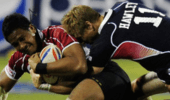
Defence - Improving Defence Game
A good Defence is about players working in units and staying "Connected". This exercise develops the skills required to improve a players understanding of what to do and when to do it
L2 - Attacking a Drift, Blitz and Cover Defence
Skill Practice Description • Within a game of touch the coach can at any breakdown - call blitz, drift and the defenders must run and touch the appropriate line. • The coach may also give players numbers in order to call specific defenders to leave the defence line which will create the need for defence to realign quickly. • Attackers must face the other way and attack when the ball is rolled from behind them. • On the coach’s call, the attack turn and the closest attacker picks up the ball and plays. • This ensures the coach can vary each player’s role and make the defence react. • Coach can then develop game by giving a visual clue to the defenders thus making the attackers react to an unexpected type of defence. Key Coaching Points • Visual Acuity-Looking for space. • Spatial awareness. • Highlighting defensive systems and attacking them appropriately. • Decision making. Relevance to the Game • This game is excellent for visual acuity and attacking differing defensive alignments. • Spaces are created by the leaving defenders, which the attackers have to identify
L2 - Scatter Defence Game
Skill Practice Description • Ideal practice for when defences break up later in games or with counter attack decision making. • Attackers stand in front of a numbered cone and ball. • The coach calls a number and all attackers must run around their own numbered cone but whichever number was called, that ball becomes active. • At the same time a colour is called for the defenders and all defenders must turn and run around a cone of that colour. They must however choose different cones. • If a touch is made, the teams swap over roles. • If a try is scored, the attackers stay the same. • First to five tries wins. Key Coaching Points • Spatial awareness • Communication • Quickness of attack at a disorganised defence • Skills to attack space • Footwork and evasion skills • Scanning skills • Decision making • Importance of getting behind defenders Relevance to the Game • Great for coaching counter attacking disorganised defences from different angles. • Any player can be ball carrier and communication is vital as is decision making in identifying space and the best way to attack it successfully • Cones can be placed to shape different types of defence. Organised or scattered
 4:15
4:15
Sevens - Uncovered - Defence
The leading international coaches explain why defence is so important and how much emphasis they put on it. This clip features a variety of tackles and techniques and post good defence the opportunity to turn the ball over. Most coaches will use a system for their defence and here are some insights
L2 - Penetrating Defence Game
Skill Practice Description • The playing area is marked out in 5m channels. • When defending, players must stay within their channel throughout the game. • The attack must look to penetrate the defence by creating and preserving space. • The defence must use a two handed touch. • There is a 5 tackle turnover rule and once possession is turned over, the defence must get into a channel as the opposition can attack immediately. Key Coaching Points • Support players to hold their opposite number as long as possible before cutting a line to take the pass. • The defender can close the space as far as the edge of their own channel. • If the support player cuts too early or the ball carrier does not move their defender enough, the support player will be touched/tackled. Relevance to the Game • This game will help develop the footwork and running lines to effectively move defenders in order to penetrate the tackle line.

HSBC - Gatland Appointed Lions Coach
Former British & Irish Lions Jason Robinson, Gavin Hastings and former Wales international Jonathan Davies commenting on the appointment of Warren Gatland as Head Coach of the 2013 British & Irish Lions Tour to Australia.
 5:39
5:39
Drift Defence from Breakdown
After starting with a defence-focused game, this drill can be used to focus on organising a drift defence from the breakdown. The four defenders touch all cones in the tackle area to simulate chaos before getting into position.
 3:46
3:46
Blitz Defence - Its simple If You Know How
When the experts explain things in simple terms it all makes sense. The Blitz defence can be confusing and delivering the coaching blocks to develop this policy can be tricky. Richard Thorpe explains things in easy to understand language
 3:31
3:31
Defence Policy - What Is It?
Richard Thorpe has been a professional player for a decade and is now an RFU level three coach. He see's defence as the key to success and in this clip explains what "Defence policy" means
 2:28
2:28
Drift Defence Game
Practice being overloaded in defence. This game teaches your players when to be patient in defence and when to go for the tackle.
 0:09
0:09
Defence - 4. Spacing
It is usual for the forwards to be defending around the break down areas. These players may need to align with tighter spacing than wider defenders for the direct attacks that may come from the breakdown. The spacing may be able to spread as the defence shape gets wider. This will prevent the defence becoming too narrow.
L2 - Attacking a Condensed Defence
Skill Practice Description • Two teams play normal touch rules. • 5 touch turnover. • When a touch is made, the game pauses and all defenders need to close in and place a hand on the shoulder of another defender. So all the defenders are bunched and in contact with each other. • The coach calls ‘play’ and the attack restarts. • The progression may be to leave one defender out of the bunch, which may provide a different challenge to the attack. • Then leave two defenders out of the bunch and slowly release the conditions to see if the attack can consistently identify opportunities to outflank or penetrate the defence. Key Coaching Points • Peripheral vision and general awareness. • Intuitive decision making. • Communication • Support and team work. Relevance to the Game • This game is designed to challenge the observation and decision making ability of the attack. • For the defence, it challenges the ability to cover quickly with both drift and sweeping defenders
Coaching 7-a-side Rugby - 7 up defence
In Defence:
Stay alert, keep on toes, specific communication, react, work hard
Defend what is happening – not what you think is going to happen
Trust the defence system, trust your team mates – trust yourself
 4:19
4:19
Geech - Lions Coaches were Years Ahead
Were the Lions coaches ahead of the game. The 1997 coaches discuss tackle techniques that are only being implemented now
 3:07
3:07
Lions Memories - Part 2/2
 0:31
0:31
Defence - 6. Groups of Three
The defence should work and communicate in groups of three. This means the individual player and the two defenders either side
 1:32
1:32
Quins Defence - 1 v 1 tackle skills
Close contact in a small channel ensures the players work their movement skills in both attack and defence. The coach reinforces the skills for contact prior to progressing this exercise
 0:23
0:23
Men's - Lineout maul good defence 3
Men's - Lineout maul good defence 3
 3:00
3:00
Game - Defence Touch
Another conditioned game that will test your players' fitness. This requires all defenders to perform a 'down-up' after each touch, before re-aligning. As players become tired, more gaps will appear, testing the defence even more.
 1:28
1:28
Attack vs Defence Continuous Drill 4V2
The attackers work to beat the defence, setting up a 'tip' (running a hard line) and 'pull back' option. They should read the defensive movements and make a decision to hit the tip option or pull out the back.
 5:47
5:47
Defence - Blitz or Drift
In the last ten years two defence systems have been coached and implemented. The Wasps academy coach provides some of the latest ideas and how to use games to coach the skills and cement the understanding
 5:51
5:51
Turning defence into attack
The Northampton saints approach to defence is to "Turn over ball" and to this end the tackle is only the start of the process and the coach outlines this approach and provides some examples
 0:04
0:04
Men's - Lineout maul good defence 1
Men's - Lineout maul good defence 1
 0:19
0:19
Men's - Lineout maul good defence 2
Men's - Lineout maul good defence 2
 0:48
0:48
Lions - Attacking channells
From the Lions 2009 tour, a support drill in a channel to encourage the ball carrier to move the defender and make space for the support player
 6:44
6:44
Coaching Defence with Games
The Wasps academy manager uses games as the central learning principe for coaching defence and the systems he wants to introduce to his players
 1:01
1:01
Defence Philosophy - Collin Osborne
Ex Harlequins coach Collin Osborne walks you through his defence philosophy and explains why your team would benefit from a philosophy or buzzword/phrase!
 6:47
6:47
Quins - Beating a Drift Defence
Some warm up exercises with varied catch & pass skills in preparation to move onto fixing defenders and how to beat a drift defence
 1:28
1:28
Quins - Defence Spacing & Line Speed
Tony Dirpose from Harlequins delivers a unit defence exercise on spacing and line speed
QBE - Attacking a Drift, Blitz and Cover Defence
QBE - Attacking a Drift, Blitz and Cover Defence
 0:34
0:34
Defence - Exit & Kick-chase
Defence - Exit & Kick Chase
 5:43
5:43
Blitz & Drift Defence Drills
This video takes you through the basics of both blitz and drift defences and provides great drill ideas.
 1:17
1:17
JWC 2012: Defence
Statistics from the 2012 JWC show that teams with stronger defences performed better.
 1:02
1:02
IRB 7s - Stronger Defences
The statistics showed that defences in the Sevens World Series are improving, and this is changing team's tactics.
 3:25
3:25
Defence
Here are some good examples of defence to help you in your coaching process
Tackling 18 - Man on Man Defence
Tackling 18 - Man on Man Defence
 0:11
0:11
Defence - 5. Team Mate Awareness
It may be that a slower forward is in the midfield defence between two faster players
These faster players should to be aware that they may need to close the space around the slower defender
 0:36
0:36
Defence - 9. Widest Players Organise
The widest players are most often best place to assess the threats and have a major role in directing the defence
 0:28
0:28
Simple hands beat Bunched Defence
When a defensive line is 'bunched up', a single pass can take several defenders out of the game. Here, Richard Hale benefit from a bunched Filton College defence, executing lateral passes along the line to attack space out wide.
 4:15
4:15
Back Row Defence
Back Row Defence

Defence - 8. Compromise Alignment
The widest defender is often better placed to assess situations
It may be that the discipline of the defence shape needs to be compromised to reduce attacking options
This is often a calculated gamble
 0:25
0:25
Women's - Lineout mail good defence
Women's - Lineout mail good defence
 0:30
0:30
Lions - Backs options from scrum
Lions 2009 clip on attacking options
 8:07
8:07
My Dream Lions Team
 6:04
6:04
Lions Memories - Part 1/2
 5:02
5:02
Warren Gatland as Lions Head Coach
 2:15
2:15
Geech - Bringing a Lions Squad Together
 6:10
6:10
Fringe Defence at the Breakdown
Building a defensive system starts with the first three defenders and what they need to do at the breakdown. The Northampton saints coaches go through the steps and progressions to help younger players learn the key movements and techniques
 0:11
0:11
Lions Strike Moves 1
Developing attack plays through the backs
 1:24
1:24
Defence - Conditioned Game
This conditioned defensive game incorporates all the tackling variations that occur during rugby union.
The coach can change the playing space to open up and provide more side-on and chase tackling, or close down the space to provide more front-on tackling as required
 1:21
1:21
Conditioned touch - Defence press up
Allow your players to put what they've learned into action. In this example, one attacker and one defender must take a knee at the tackle area to resemble the breakdown.
 1:05
1:05
British Lions - scrum practice 2
Progressiing the scrum practice always requires the underlining of the basics of the unit skill
 0:49
0:49
British Lions - play from scrum with wheel practice
Using the wheel effectively opens up areas of space on the pitch to attack
 1:41
1:41
Lions - play from scrum - continuity
Developing play from the scrum is an important part of the understanding of how the scrum is part of a gameplan
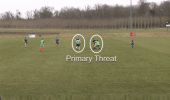
Defence - 1. Primary Threat
If the ball is tucked under one arm, the ball carrier is unlikely to throw a 10 metre miss pass. So are the attackers 2 and 3 places out the primary threat?
If the ball carrier is running with the ball in both hands, the immediate threat may have a wider radius
If two centres are running at a centre and a prop, the primary threat may be the space defended by the prop
 0:47
0:47
British Lions - Play from scrum - continuity 2
Developing play from the scrum is an important part of the understanding of how the scrum is part of a gameplan
 0:08
0:08
Defence - 3. Press Up and Out
This illustration is an up-and-out system and not a drift
This relies on the defenders continuing to press forward, closing the space as they shadow the attacking players
 0:30
0:30
British Lions - play from wheeled scrum going left
Developing play from the scrum is an important part of the understanding of how the scrum is part of a gameplan